-
Written by Maduagwuna Francisca Chidili
August 12, 2024 | 9:43 pm UTC+0
Introduction
A festival is defined as a day or time of religious and other celebrations marked by feasting, ceremonies, and other observances (www.freedictionary.com).
There are different types of festivals in the world at large and in Nigeria in particular, e.g. religious, spiritual, and cultural festivals.
In Nigeria, there are the Argungu Fishing Festival in Argungu, Kebbi State; Osun-Osogbo Festival in Osun State; Afan National Festival in Southern Kaduna; New Yam Festivals celebrated in most Igbo communities; and the Ikeji Festival celebrated in Arondizuogu in Imo State. These festivals and others are celebrated in different parts of the country to commemorate certain events. Cultural festivals have always symbolized peace, reconciliation, and celebration. They are also celebrated to cherish the abundant blessings from the gods.
Cultural festivals are unique in the lives of different communities. Nothing depicts a people’s total way of life as explicitly as the celebration of a cultural festival. Within the framework of the celebration, vital components that form the worldview of the community are usually put on display through various cultural acts such as energetic dancing, music, and drumming. These celebrations are often amplified with colourful costumes, culinary delights, and lots of drinks. The Ikeji Festival of Arondizuogu is one of these festivals that has stood the test of time in Nigeria.
GEOGRAPHICAL LOCATION OF ARONDIZUOGU
Arondizuogu is located in Imo State of Nigeria. Its settlement is spread across three Local Government Areas of Imo State, namely Ideato North, Okigwe, and Onuimo. It is a large community occupying a vast expanse of land. It is presently located on land obtained from Umualaoma town (formerly Isi-Okpu). It is believed that these lands were obtained through warfare and open massacre of the people of Umualaoma and their neighbouring communities.
INTERESTING HISTORICAL SITE
There are many historical sites in Arondizuogu, but my attention is drawn to Mazi Ojike Mbonu Cottage (village of the late Boycott King), located at Ndi-Akame Uno. It is called Uno Ogologo II (Tall House II). It served as a safe house in 1887 for hiding children from being captured and sold into slavery.
ORIGIN OF THE PEOPLE OF ARONDIZUOGU
Arondizuogu is a town inhabited by the Igbo subgroup, the Aro people, in Imo State of Nigeria. The people of Arondizuogu are believed, like other Aros, to have migrated from Arochukwu in the present Abia State, Nigeria. According to history, Arondizuogu was founded through the use of force by Mazi Izuogu Mgboko and his brothers in the mid-14th century. Izuogu Mgboko was said to have been a charismatic slave merchant who came from Arochukwu to Awka in search of slaves. He was usually harboured by a friend from Umualaoma when going in search of slaves and with his goods (slaves who maintained his name even after they were freed).
Izuogu Mgboko had three sons and three brothers who gave birth to these villages, e.g. Ndiuche, Ndiawa, Ndiamazu, Ndiimoko, Ndinjoku, Ogbuonyeoma, Amankwu, Ekwuru, etc. Iheme was Izuogu’s chief servant and came from Isi-Akpu Nise near Awka. Iheme and Izuogu, his master, used all the weapons at their disposal to secure several vast areas of land that presently constitute Arondizuogu. This is the reason why the people of Arondizuogu refer to themselves as “Izuogu na Iheme.”
There was also another warrior named Okoli Idozuka. He was a great warrior and equally came from Isi-Akpu Nise near Awka. He contributed to the expansion of the boundaries of Arondizuogu. Presently, Arondizuogu is the largest among the Aro colonies.
ORIGIN OF THE IKEJI FESTIVAL
The Ikeji Festival, which takes place annually around March and April in Arondizuogu, Imo State, Nigeria, is believed to have as many as four versions.
The first version is that a warrior named Dikeji from Arondizuogu conquered a village and made it compulsory for the king to pay tribute. The tributes stopped coming after some time, which made Dikeji return to that village, behead the king, and bring his head back to his hometown, where the event was celebrated as Ikeji Ugwo.
The second version talks of an individual named Izuogu, who was the founder of Arondizuogu. He went to Arochukwu, where he was kidnapped and was fortunate to have been saved by three masked figures whom he believed must have come from Abam. Upon gaining his freedom, Izuogu held a celebration that was initially celebrated as “Ike Ji M Aka,” meaning “a strong hand is holding me.”
The third version is a bit odd, as it is connected to the slave trade. The Aro people at that time always had the omu charm to protect themselves, as they were never afraid of being captured as slaves. In a scenario where they were being captured without the omu charm, all they had to do was utter the words “Aka Ike Jim” (“a strong hand is holding me”). The slave merchant would immediately release them for fear of incurring the wrath of the famous juju of Arochukwu, a powerful deity known as Ebini-Ukpabi. Thus, the festival began as a commemoration of the Aros killed during the slave trade.
The fourth version links the festival to the New Yam Festival celebration in Arochukwu around September of every year, which is also common among the Igbos. Yam is central to the Ikeji Festival, and only men plant yam in traditional Arondizuogu society. This is why some names are derived from yam, e.g. Okparaji (son of yam), Ezeji (king of yam), Ugoji (eagle yam), Omeji (beloved yam), etc.
CELEBRATION OF IKEJI (STRENGTH OF YAM) FESTIVAL
The Ikeji Festival is celebrated in the month of March or April annually in Arondizuogu, descendants of the Arochukwu people. A similar festival is also celebrated in Arochukwu with a different name in September of every year. The cultural celebration marks both the end of the planting season and the beginning of harvesting.
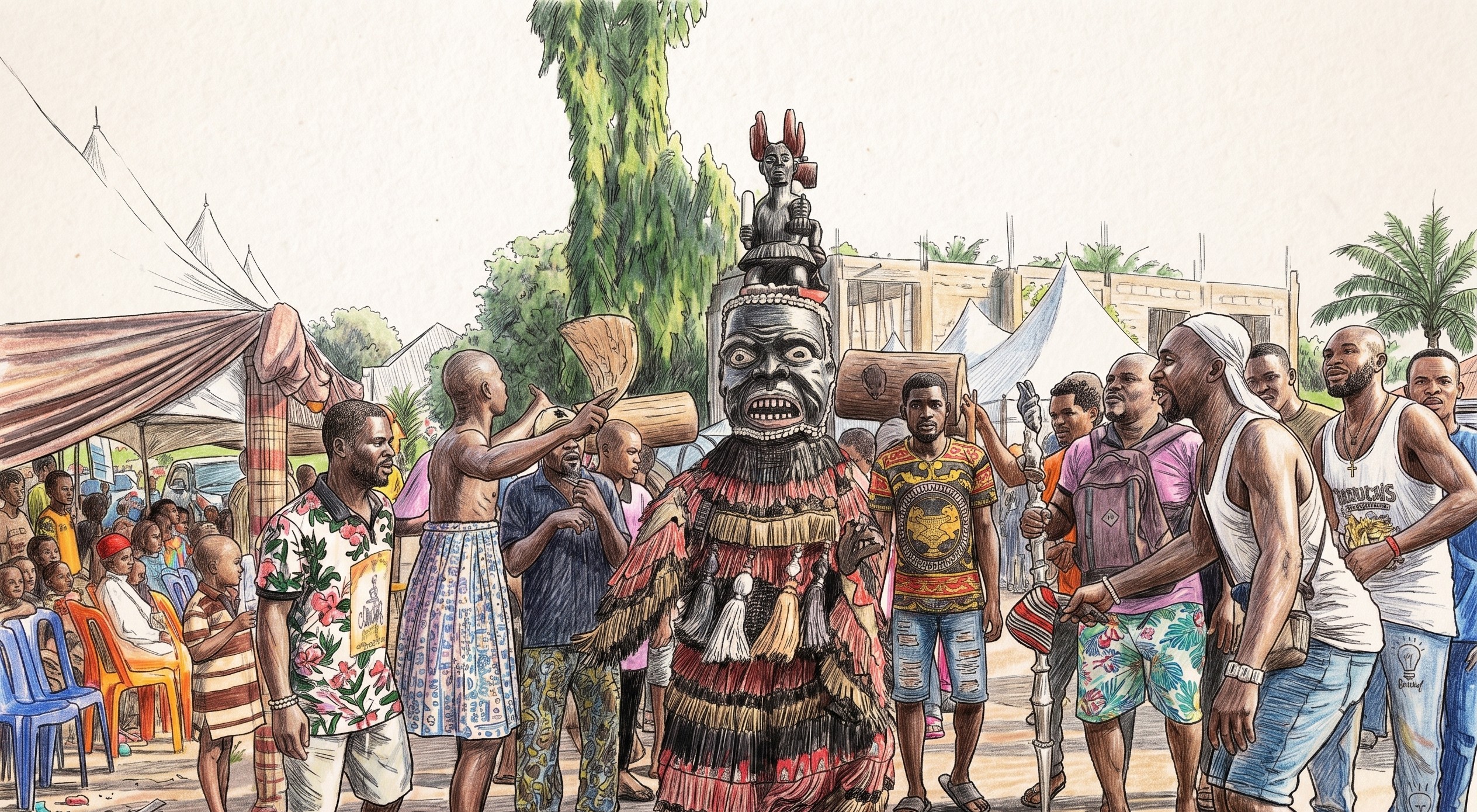
The celebration is usually filled with different types of masquerades, music, and dancing. The Ikeji Cultural Festival celebration is spread across four Igbo market days, namely Eke, Orie, Afor, and Nkwo. Each of the market days has specific activities.
On the first day of the celebration, being Eke market day, the best farm produce are brought to the Eke market, where they are sold at very cheap prices.
The second day, being Orie market day, is for the slaughtering of livestock by every family.
On the third day, being Afor market day, there is feasting in every family. On the same third day, masquerades come out to display, with several dance groups joining them.
On the fourth day, being Nkwo, is the grand finale of the festival. The big masquerades (Nnekwu Mmanwu) make their appearances, dancing with regal steps and dressed in their most appreciated regalia or costumes.
Nkwo Achi is everyone’s destination, as it is the central venue of the Ikeji Festival celebration. This day is usually the most colourful, as it showcases different dance groups representing the different villages that make up the town. There is usually a lot of eating and drinking in every family before moving to the venue, Nkwo Achi, to properly witness the festival.
It is expected that everyone, both indigenes and visitors, converges at the venue to enjoy the festival as the big masquerades move around, attracting people’s attention in different ways.
Whips made from young, malleable branches of palm trees, known as mgbajara or akpata, are twisted nicely and used to flog members of different masquerade groups to test their strength in withstanding opponents and intruders. They are also used to scare opponents as they use the whips to display fetish-looking acts. Some of the masquerades and their followers are seen carrying water in baskets, which defies the laws of science.
A usual juju contest is the “Ito Ebule Ikeji”—the untying of the Ikeji ram. The juju contest, which is one of the attractions at the event, takes place at a particular spot at the venue where the act of Ito Ebule, the untying of the Ikeji ram, takes place.
Here, a big ram is tied to a tree with a tiny rope which, ordinarily, the ram could break loose from, but cannot achieve that due to some magical powers (voodoo). Among the participants or invited guests, someone is usually summoned to go and untie the ram. This can only be achieved by a man with the strongest or most powerful dibia (native doctor). He is expected to walk confidently to the ram and loosen it.
As he does this, he is confronted by spiritual attacks from other participants, aimed at preventing him from achieving his aim or even killing him. At the end of the day, whoever unties the ram wins the juju contest for that day. The winner takes the ram home for feasting with his kinsmen.
Children are not left out of the festivity, as they make small masks and sacks and wear them on their faces and bodies to attract visitors and receive small amounts of money (dash) from them.
Assorted masquerades are displayed at the festival, and some of them are Ojionu, Mgbedike, and Agbogho Mmanwu. The musical instruments used are a sight to behold, as they produce soulful sounds. They are as follows: ekwe (wooden gongs), oja (flutes), ogene (metal gongs), ichaka (beaded calabash), mgbirigba (bells), and okom (very large wooden drums).
These instruments are played together to produce enchanting traditional sounds that encourage the masquerades and dancers to bring out the best in them.
SOCIAL IMPORTANCE
In most Aro settlements, the Ikeji Festival serves to foster ties with Arochukwu and distinguish the Aro in Imo State from the indigenous people among whom they settled (Eli Briton, Cole & Aniakor, 1985).
The Ikeji Festival does not only underscore facets of the people’s past, but it also provides entertainment and relaxation after a year’s work. The Ikeji Festival symbolizes peace, reconciliation, and celebration.
Life is all about happiness, and as humans, social interaction with our fellow beings not only brings happiness but also helps us to forget our worries and celebrate the positive side of life, even if it is for a few days.
It provides an opportunity to reduce friction and bring estranged friends together. Ikeji festivals act as stress relievers and help people to balance their emotions.
The Ikeji Festival, just like other festivals, gives people the opportunity to interact with people from different tribes and places. The festival also gives the indigenes the opportunity to form relationships with visitors, and these relationships could be of great importance to both the locals and the visitors.
CULTURAL SIGNIFICANCE
It is often said that the goodness of a culture is embedded in its festivals. Cultural festivals such as Ikeji demonstrate the creativity and cultural values of the Arondizuogu people and, by extension, the Igbos of Southeastern Nigeria.
It tends to provide deeper knowledge of the life of the people.
The Ikeji Festival celebration helps the people to build community pride, especially outside the country, e.g. in the USA, where indigenes of Arondizuogu hold a minimal celebration to mark the event. By doing so, they showcase their rich culture and that of Nigeria to the outside world.
The Ikeji Festival serves as a great way to celebrate the rich culture of the people. It serves as a great way to celebrate culture and meet new people. Its celebration helps the people to learn about the culture and customs of the community.
SPIRITUAL SIGNIFICANCE
Before the commencement of the Ikeji Festival, some Aro men from Arochukwu make sacrifices in order to bridge the gap between the head of each family or the eldest man in every family and the gods.
The eldest man is entrusted with the responsibility of performing the rites of Ikeji. He invokes the spirits of the Ndichies (ancestors) through a carved symbolic sacred wood and pours libations on them while calling upon them to come and accept kolanuts.
Some men are authorized by the secret society of the Arondizuogu community to dress up as ancestral spirits in what is called masquerades. They are accompanied by a bell bearer who explains to the crowd the message from the spirit world, which usually consists of blessings for a bountiful harvest to come.
As the masquerades go through the villages, they perform rituals, killing chickens and goats to appease the gods and seek their blessings.
There are usually wooden and metal boxes which are believed to contain juju (magical powers). These are poured on some men’s heads throughout the twenty villages that make up Arondizuogu as another way of communicating with the gods.
Cleansing of the body is another ritual believed to wash away the previous farming season and prepare for the next.
ECONOMIC BENEFITS OF IKEJI FESTIVAL
Inasmuch as the Ikeji Festival enhances cultural exchange, it also provides commercial space for the community to sell their goods and products. The inflow of visitors and the mass return of indigenes to Arondizuogu during the Ikeji Festival boost the economic well-being of the people due to the huge patronage of local traders.
The hotels, beer parlours, and restaurants are not left out, as they are highly patronized by people who have come to witness the festival.
The filling stations equally make a lot of sales on petrol and diesel. The telecommunication industries are economically boosted due to huge sales of recharge cards and data, as people communicate and share the event via WhatsApp, Facebook, Instagram, etc.
The festival also holds a lot of potential for the tourism industry, as tourists are usually given a warm welcome whenever they visit to experience this rich culture.
MODERN-DAY CHALLENGES
Sophistication
The Ikeji Festival requires a lot of time to practise the traditional songs, dances, and general cultural displays. The younger generations do not have the time to do all of these, and this is really affecting the festival.
Rituals
A lot of rituals are involved, making the practice not only for fun. From its inception, people prayed to the gods and performed rituals. Presently, a lot of people are no longer interested, which has resulted in the ritual aspect of the festival becoming less prominent.
Social Media
Social media has dealt a big blow to the festival. A lot of people, rather than travelling to Arondizuogu to witness the festival, depend on social media to watch the festival.
Greener Pastures
The urge by youths to travel outside their community in search of greener pastures has negatively affected this rich cultural festival by reducing the number of men needed to wear the headdresses and face masks and to participate in the energetic dances.
Economic Situation
The economic situation has brought about a hike in transport fares on both air and road transport. This contributes to the inability of some people to travel to the village to enjoy the festival, hence causing a low turnout of people.
CONCLUSION
We are dependent on social heritage, which is a mixture of customs, attitudes, festivals, moral values, folklore, and ideas, not only to make us who we are but also to bind us together and enable us to pass these values from one generation to another.
The Ikeji Festival, having survived high levels of antagonism, has to be accepted as an intangible cultural heritage worthy of preservation.
Some of these cherished and valuable antiquities, such as different Igbo headdresses, face masks, masquerade clothing, and different types of Igbo traditional musical instruments preserved in our museums, were once used for this rich festival. Some of these items have been kept and have lasted several years in different families in Arondizuogu.
We must not allow some of these rich festivals to fade away.
REFERENCES
– www.wilkiwand.com/ikeji-festival
– m.facebook.com/posts/the-original
– punching.com/imo-community-fix
About the Author
Maduagwuna Francisca Chidili is an Assistant Chief Curator with National Museum Lagos State, Nigeria.
Ikeji Cultural Festival of Arondizuogu in Imo State, Nigeria