-
Written by Nwaokobia Stephanie Chinonso, Okolie Ogochukwu, and Ayodele Adewale Abiodun
October 28, 2025 | 10:33 pm UTC+0
Introduction
Museums are often imagined as quiet places of history—buildings filled with ancient objects, glass cases, labels, and carefully arranged exhibitions. To the public, they are spaces of learning, tourism, and cultural reflection. Yet behind the calm atmosphere of galleries lies a far more complex responsibility: the continuous struggle to protect fragile cultural materials from destruction, theft, neglect, environmental damage, and time itself.
Within museum practice, conservation and security are frequently discussed as separate responsibilities. Conservation is commonly associated with preservation, environmental monitoring, restoration, storage, and the physical care of collections. Security, on the other hand, is often reduced to guards, surveillance cameras, alarms, and visitor control. In reality, however, both fields are deeply interconnected. A museum object cannot be properly conserved if it is not adequately secured, and security itself loses meaning if collections continue to deteriorate under poor environmental conditions.
This relationship between security and conservation is increasingly becoming one of the most important but least publicly understood aspects of museum management. Across Africa and many developing regions of the world, museums face growing threats that extend beyond theft alone. Climate instability, flooding, pest infestation, poor infrastructure, fire outbreaks, overcrowded storage, unstable electricity, poor documentation systems, vandalism, and inadequate handling procedures all contribute to the vulnerability of collections. In many cases, damage occurs not through dramatic criminal acts, but through slow institutional weaknesses that gradually undermine preservation efforts.
The challenge becomes even more significant because museum objects are unlike ordinary possessions. They are often irreplaceable. A stolen television can be replaced. A damaged office chair can be repaired or discarded. But a sixteenth-century ivory mask, a sacred ritual object, an archaeological bronze, or an ancestral manuscript carries historical, spiritual, artistic, and cultural meanings that cannot be reproduced once lost. When such objects disappear or deteriorate, societies lose part of their historical memory.
This reality places enormous responsibility on museums. They are not merely custodians of objects but guardians of identity, collective memory, and cultural continuity. Every exhibition gallery, storage room, conservation laboratory, and archive therefore becomes part of a larger defence system designed to preserve history against both visible and invisible threats.
Conservation and Security: Two Sides of the Same Responsibility
One of the greatest misconceptions about museum security is the assumption that protection begins and ends with physical surveillance. In reality, the first line of security often begins with preventive conservation. An object that is properly stored, documented, monitored, and handled is significantly less vulnerable to loss or deterioration. Poor storage systems create confusion, increase accidental damage, and make theft easier to conceal. Weak environmental control encourages mould growth, corrosion, cracking, and biological infestation. Inadequate documentation creates opportunities for illegal substitution, trafficking, or disappearance of objects without detection.
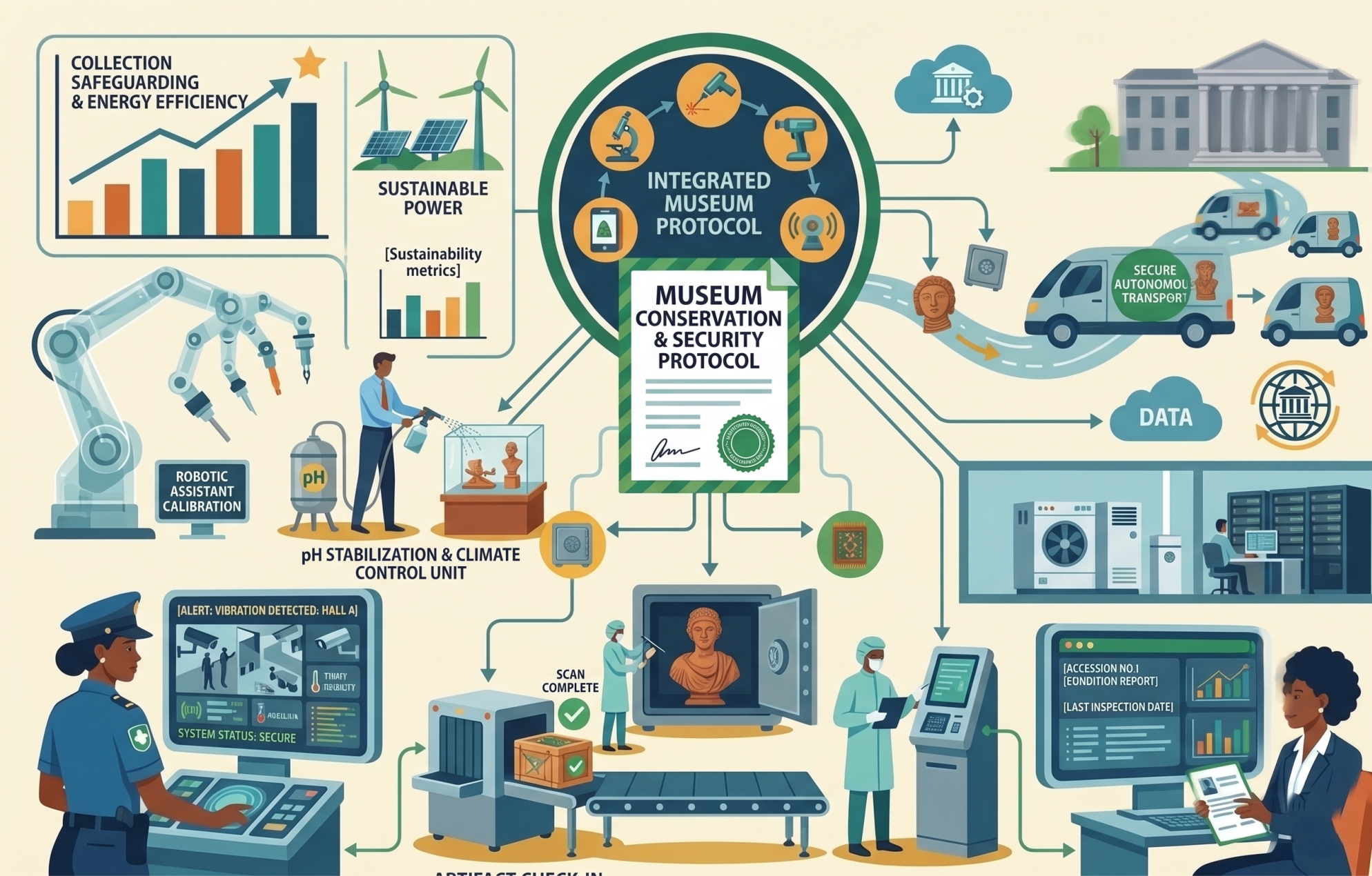
For this reason, modern museum practice increasingly recognizes conservation itself as a form of security. Temperature regulation, humidity control, integrated pest management, emergency preparedness, proper shelving systems, condition reporting, and digitized inventory systems are no longer viewed only as conservation procedures; they are essential protective mechanisms.
Contemporary Threats to Museum Collections
The importance of this relationship becomes clearer when examining the history of cultural loss globally. Some museum collections have disappeared through organized theft and illicit trafficking, while others have been destroyed by war, environmental disasters, fire, political instability, and institutional neglect. In several African countries, inadequate infrastructure has exposed collections to leaking roofs, fluctuating temperatures, flooding, and overcrowded storage conditions. In such environments, even the most valuable collections remain vulnerable.
The illegal trade in cultural property also continues to threaten museums worldwide. Smuggling networks often target poorly documented collections and institutions with weak security systems. Once objects enter international black markets, recovery becomes extremely difficult. African antiquities, ritual objects, sculptures, manuscripts, and archaeological materials have repeatedly appeared in foreign private collections and auction houses after disappearing from poorly protected sites and institutions.
Yet physical theft represents only one dimension of the problem. Environmental deterioration can be equally destructive. Wooden sculptures crack under unstable humidity. Metals corrode when exposed to moisture. Textiles weaken through light exposure and fluctuating environmental conditions. Paper records deteriorate through acidity, insects, and damp storage. Biological infestations silently consume organic collections over long periods before visible damage becomes apparent. In many museums, deterioration occurs gradually and quietly, making it less dramatic than theft but often far more widespread.
Preventive Conservation as the First Line of Defence
This is why preventive conservation has become central to modern heritage protection strategies. Unlike restoration, which intervenes after damage has occurred, preventive conservation focuses on reducing risk before deterioration begins. It recognizes that long-term preservation depends less on repeated repair and more on stable environments, proper planning, and continuous monitoring.
Environmental monitoring systems now play critical roles in museum security infrastructure. Temperature and humidity sensors help institutions detect dangerous fluctuations before irreversible damage occurs. Fire detection systems protect collections from catastrophic destruction. Controlled lighting reduces fading and material breakdown. Specialized storage furniture minimizes physical stress on fragile objects. Even housekeeping routines contribute to preservation by reducing dust, pollutants, and pest activity.
Infrastructure, Energy and Sustainable Collection Care
However, implementing these systems remains a major challenge for many museums, particularly within developing countries. Financial limitations often force institutions to operate with inadequate storage spaces, obsolete equipment, insufficient staffing, and weak maintenance structures. In regions with unstable electricity supply, climate control systems frequently fail, exposing collections to repeated environmental fluctuations. Generators provide temporary solutions but increase operational costs significantly.
The sustainability dilemma therefore becomes unavoidable. Museums require stable environments to protect collections, yet the energy demands of conservation systems can be financially and environmentally difficult to sustain. This tension has encouraged increasing interest in sustainable conservation approaches that rely more heavily on passive environmental control, improved building design, natural ventilation, insulation, and locally adapted storage strategies.
Traditional African architectural knowledge is increasingly being reconsidered within this context. Many indigenous building systems historically responded effectively to local climates using natural airflow, shading techniques, thick walls, courtyards, and environmentally responsive materials. Some museum professionals now argue that sustainable conservation in Africa should combine modern scientific standards with local environmental knowledge rather than relying entirely on imported conservation models designed for different climatic realities.
Technology and Digital Security in Museum Management
At the same time, technology is reshaping museum security in important ways. Digital cataloguing systems, barcode tracking, RFID technology, high-resolution photography, and 3D documentation are improving collection accountability and monitoring. Digitization not only preserves information about objects but also strengthens security by creating detailed identification records that assist in recovery if theft occurs.
The role of documentation in museum security cannot be overstated. An undocumented object is vulnerable not only to deterioration but to disappearance. Accurate inventory systems allow institutions to track movement, assess condition changes, detect missing items, and maintain accountability across departments. In many heritage theft investigations worldwide, recovery efforts have depended heavily on photographic records and detailed cataloguing.
Human Capacity and Professional Competence
Human factors remain equally important. Security personnel, conservators, curators, registrars, technicians, cleaners, and exhibition staff all contribute to collection protection. In some cases, insider negligence or inadequate training creates vulnerabilities more dangerous than external threats. Mishandling during transportation, poor packing procedures, accidental exposure to environmental hazards, and improper storage can cause severe damage without malicious intent.
Training therefore becomes essential. Museum personnel must understand not only how to secure collections physically but also how environmental conditions, handling methods, and institutional procedures affect long-term preservation. Security in museums is no longer limited to policing spaces; it involves risk management, environmental awareness, emergency preparedness, and interdisciplinary collaboration.
Disaster Preparedness and Emergency Response
Emergency planning has become especially important in recent years due to climate-related disasters. Flooding, storms, heatwaves, and fire outbreaks increasingly threaten heritage institutions worldwide. Many museums now develop disaster preparedness plans that include evacuation procedures, emergency freezing of wet materials, salvage priorities, backup documentation systems, and staff response training.
Unfortunately, many African museums still lack comprehensive disaster preparedness frameworks despite increasing environmental risks. Collections remain exposed to seasonal flooding, deteriorating infrastructure, and inadequate emergency response systems. This situation highlights the urgent need for stronger government investment in heritage protection infrastructure.
Public Engagement and Heritage Stewardship
Public awareness also plays a critical role in museum security and conservation. Heritage protection cannot remain solely an institutional responsibility. Communities that understand the significance of museum collections are more likely to support preservation initiatives, resist illicit trafficking, and advocate for better funding and policy support. Public engagement transforms museums from isolated institutions into shared cultural responsibilities.
Educational outreach therefore becomes part of preservation itself. When visitors understand why flash photography is restricted, why touching objects is prohibited, or why environmental control matters, they become participants in conservation rather than passive observers. Public understanding strengthens institutional protection.
Repatriation and Shared Responsibility
Equally important is the growing conversation surrounding repatriation and the return of African cultural objects from foreign institutions. As restitution debates continue internationally, questions surrounding conservation infrastructure and museum security within receiving institutions increasingly emerge. Some foreign institutions raise concerns about storage conditions, environmental control, and protection capacity within African museums.
While such concerns should not be used to justify indefinite retention of African heritage abroad, they nevertheless highlight the importance of strengthening conservation infrastructure locally. Repatriation must therefore be accompanied by investment in conservation training, storage facilities, environmental systems, and museum security development. Heritage return without preservation capacity risks exposing vulnerable objects to new forms of deterioration.
Building Resilient Museums for the Future
Despite these challenges, museum professionals across Africa continue to demonstrate remarkable resilience and innovation. Conservators adapt locally available materials for storage and stabilization. Curators improve documentation systems despite limited resources. Technicians maintain outdated environmental systems under difficult conditions. Security staff protect collections with inadequate equipment and staffing. These efforts, though often invisible to the public, form the quiet foundation upon which heritage survival depends.
Ultimately, the relationship between conservation and security reflects a broader truth about museums themselves. Preservation is not simply about objects; it is about continuity. Museums protect evidence of who societies were, how they evolved, what they believed, and what they created. Every object carries stories of craftsmanship, ritual, governance, memory, conflict, identity, and human imagination. To protect such objects requires more than walls, cameras, and alarms. It requires environmental stability, documentation, professional training, sustainable planning, institutional commitment, and public support.
Conclusion
Security without conservation becomes temporary protection. Conservation without security becomes vulnerable preservation. The future of heritage protection therefore depends on recognizing both as inseparable responsibilities. Because when museums fail to protect collections, the loss extends beyond physical materials. What disappears is part of a society’s memory itself. And once memory disappears, rebuilding identity becomes far more difficult than preserving it in the first place.
References
Ambrose, T., & Paine, C. (2018). Museum Basics (4th Edition). Routledge, London.
Canadian Conservation Institute (CCI). (2023). Agents of Deterioration and Preventive Conservation. Government of Canada.
ICCROM. (2011). Reducing Risks to Cultural Heritage. International Centre for the Study of the Preservation and Restoration of Cultural Property, Rome.
ICOM. (2017). ICOM Code of Ethics for Museums. International Council of Museums, Paris.
Keene, S. (2005). Fragments of the World: Uses of Museum Collections. Elsevier Butterworth-Heinemann, Oxford.
National Commission for Museums and Monuments (NCMM). (2023). Museum Management, Collection Care and Heritage Preservation in Nigeria. Abuja, Nigeria.
Pye, E. (Ed.). (2001). Caring for the Past: Issues in Conservation for Archaeology and Museums. James & James Science Publishers, London.
UNESCO. (1970). Convention on the Means of Prohibiting and Preventing the Illicit Import, Export and Transfer of Ownership of Cultural Property. Paris.
UNESCO. (2015). Recommendation Concerning the Protection and Promotion of Museums and Collections. Paris.
Waller, R. (2003). Cultural Property Risk Analysis Model: Development and Application to Preventive Conservation. Canadian Museum of Nature, Ottawa.
About the Authors
Nwaokobia is a Conservator and Researcher at the National Museum, Lagos. She is actively engaged in the preservation of cultural heritage, with research interests in preventive conservation, museum collection management, digitization, and sustainable heritage preservation.
Okolie is a Conservator at the National Museum, Lagos. Her professional work centres on the conservation, documentation, and preventive care of museum collections, with a commitment to promoting best practices in heritage preservation.
Ayodele is an antiquity protection professional with National Museum, Lagos. He specializes in cultural property protection, museum security, heritage law enforcement, and the prevention of illicit trafficking in cultural objects.
Safeguarding Memory Conservation and Security in the Modern Museum