-
Written by Ihuoma Jennifer Metuaghan & Chidiebere Ojogho
March 4, 2025 | 10:17 pm UTC+0
Introduction
Nigeria’s material history is a profound testament to human ingenuity. The intricate terracotta of the Nok culture, the classical naturalism of Ife and Owo arts, the sacred soapstones of Esie, and the world-renowned bronze castings of the Benin Kingdom are more than masterworks—they are the irreplaceable bedrock of national identity. Yet, this rich cultural patrimony remains under constant siege from organized transnational trafficking networks. Driven by lucrative foreign art markets, illicit excavations and museum thefts actively strip the nation of its history.
While international treaties provide a framework for recovery after the theft has occurred, the most effective defense must happen at the borders. Within the statutory architecture of the National Commission for Museums and Monuments (NCMM) Act, two administrative instruments serve as primary, proactive mechanisms to halt illegal transit: the Export Permit and the Clearance Permit. Together, these regulatory tools create a formidable gatekeeping system that deters smugglers and secures Nigeria’s material heritage.
Deconstructing the Permitting Mechanisms
To understand how these permits function as active enforcement tools, one must differentiate their specific operational roles within Nigerian curatorial practices. They are not merely bureaucratic paperwork; they are distinct legal barriers designed to intercept different categories of material culture before they depart Nigerian soil.
The Clearance Permit: Verifying Contemporary Art and Replicas
The vast majority of objects leaving Nigeria under the label of “art” are contemporary pieces—modern paintings, sculptures, souvenirs, and replica carvings destined for the global market. However, traffickers routinely exploit this legitimate trade by intermingling genuine antiquities within crates of modern crafts.
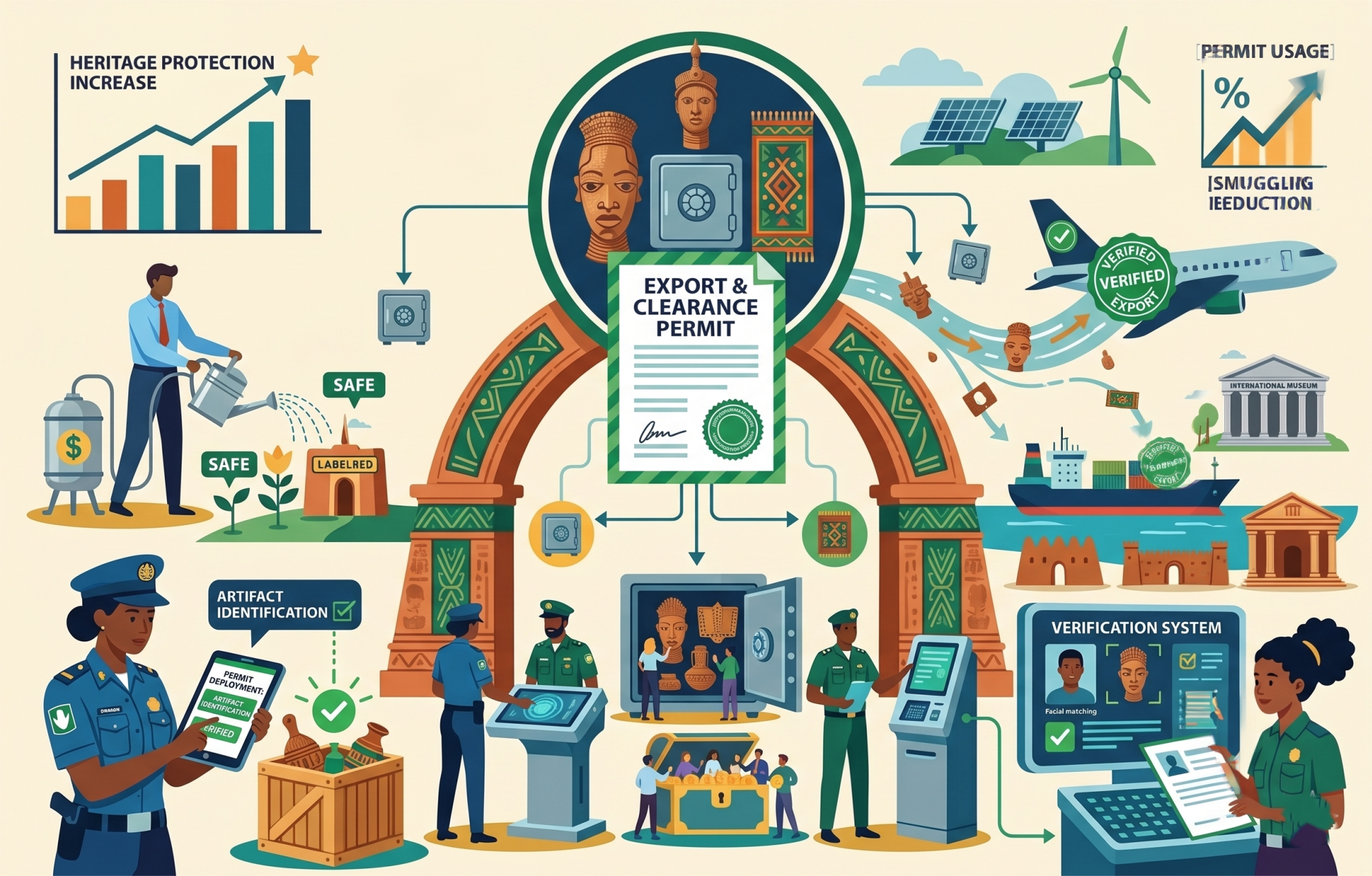
The Clearance Permit is the NCMM’s diagnostic tool against this tactic. Any individual wishing to travel out of Nigeria with an artwork must present the physical object to an NCMM museum station for scrutiny. Curators meticulously assess the object to verify that it is indeed a contemporary production or a newly made replica. Once validated, the museum assesses a 10 percent fee based on the artwork’s value, which is paid directly into the government’s purse, and issues an official Clearance Permit. This process effectively isolates contemporary items and prevents authentic antiquities from being mislabeled as modern tourist souvenirs.
The Export Permit: Managing Temporary and Scientific Transit
Unlike a Clearance Permit, which allows contemporary art to leave permanently, an Export Permit is explicitly reserved for authentic antiquities. Under Section 25 of the NCMM Act, the permanent export of Nigerian antiquities is strictly prohibited. Therefore, an Export Permit is only granted under exceptional, temporary circumstances, such as international traveling exhibitions or specialized archaeological and scientific research.
Before this permit is signed, the applicant and the object undergo rigorous institutional investigation. The permit serves as a legal covenant, explicitly stipulating strict timeline conditions and ensuring that the object is thoroughly documented, tracked, and returned to its host museum in Nigeria upon completion of the approved timeline.
Closing the Gaps Through Inter-Agency Synergy
A permit system is only as powerful as its frontline enforcement. Because museum curators do not stand at airport tarmacs or deep-sea shipping ports, the operational success of the NCMM permitting system relies on deep synergy with Nigeria’s border control agencies.
Traffickers historically bank on border officials being unable to distinguish an authentic, ancient Ife terracotta head from a well-aged modern clay replica. To disrupt this vulnerability, the NCMM maintains a coordinated alliance with the Nigeria Customs Service, the Nigeria Immigration Service, and the National Security and Civil Defence Corps (NSCDC). Under statutory provisions, Customs officers possess special powers to search outbound cargo without a warrant if they suspect an illegal antiquity export. By training border personnel to look specifically for NCMM-issued security watermarks on Clearance and Export Permits—and to immediately detain any cultural object lacking this paperwork—the state transforms its ports of exit into impenetrable security checkpoints.
The Global Power of the Permitting System
The impact of Nigeria’s internal permit system extends far beyond its physical borders. Under the UNESCO 1970 Convention on the Means of Prohibiting and Preventing the Illicit Import, Export and Transfer of Ownership of Cultural Property, international law binds signatory nations to respect the export laws of source countries.
A landmark manifestation of this is the Cultural Property Implementation Act (CPIA) agreement signed between Nigeria and the United States. Under this bilateral pact, any archaeological or ethnological material originating from Nigeria that arrives at a U.S. border without a verified NCMM Export Permit or Clearance Permit is automatically subject to immediate seizure. The burden of proof is flipped onto the importer. Instead of Nigeria spending years wading through costly, labyrinthine foreign court battles to repatriate a smuggled object, the absence of the official Nigerian permit triggers automatic confiscation and return.
A Sovereign Defense
The rigorous implementation of Export and Clearance Permits provides an effective, localized framework for protecting Nigeria’s cultural assets. By forcing all cultural exports through a process of physical curation, verification, and inter-agency border monitoring, Nigeria aggressively disrupts black-market supply lines. These permits do not merely regulate commerce; they stand as an assertive statement of cultural sovereignty, ensuring that the material genius of Nigeria’s ancestors remains protected within the borders of the nation that created it.
Conclusion: Border Control as Heritage Preservation
The rigorous enforcement of Export and Clearance Permits represents far more than an administrative hurdle, it is a frontline imperative for national security and cultural preservation. By subjecting all outbound cultural objects to expert physical curation and verification, Nigeria systematically closes the loopholes that transnational trafficking networks have long exploited.
Furthermore, when this internal permitting system is backed by seamless inter-agency cooperation at home and reinforced by international bilateral agreements abroad, it transforms from a localized check into a globally recognized legal barrier. Ultimately, ensuring that no artifact leaves Nigerian soil without an unassailable paper trail is an assertive act of cultural sovereignty. It guarantees that the material legacy of Nigeria’s ancestors is actively defended, preserved, and kept where it truly belongs: within the borders of the nation it defines.
The Twin Pillars of Border Security: Deploying Export and Clearance Permits to Curb Artifact Trafficking in Nigeria