-
Written by Ihuoma Jennifer Metuaghan
September 20, 2025 | 10:55 pm UTC+0
Introduction
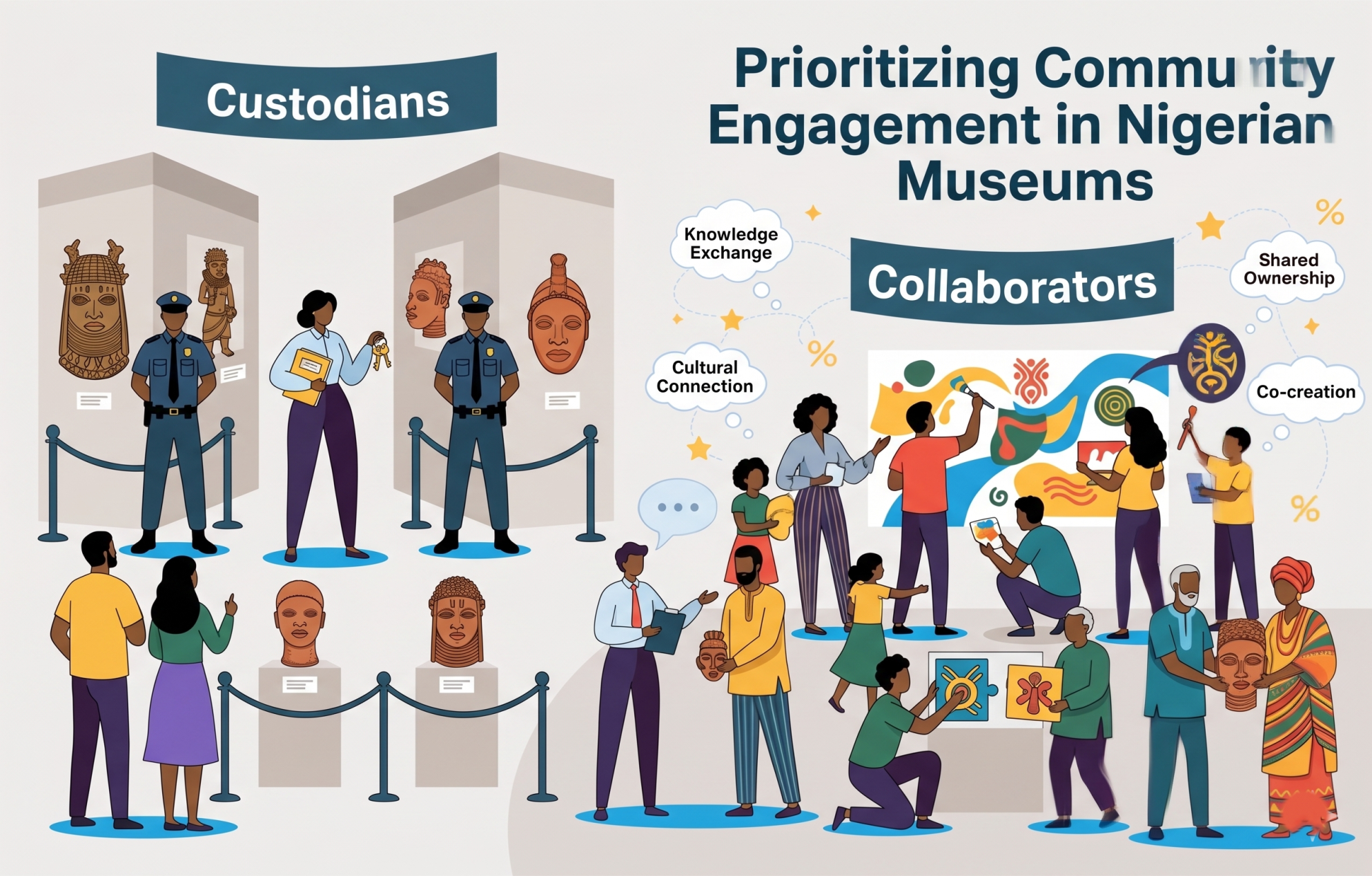
For generations, the traditional museum model in Nigeria has functioned primarily as a somber vault of the past. Visitors walked through quiet, dimly lit corridors of institutions managed by the National Commission for Museums and Monuments (NCMM), viewing sacred carvings, royal regalia, and ancient terra-cottas separated by thick panes of glass. In this legacy framework, the museum acted as an absolute authority—a distant custodian of a culture that felt detached from the vibrant, chaotic, and living realities of the communities right outside its gates.
However, a profound shift is occurring. Driven by a global push toward cultural repatriation, grassroots advocacy, and initiatives like the international Museums Lab network, Nigerian museums are undergoing a major evolution. True preservation is no longer seen as merely keeping artifacts behind glass; it requires actively weaving those artifacts back into the social fabric of the people who created them. Prioritizing community engagement is no longer just a progressive curatorial choice—it is a vital requirement to keep Nigeria’s heritage alive, democratic, and relevant.
Dismantling the Colonial Monologue
To understand why community engagement is so vital, one must look at the origin of modern museums in West Africa. Many were established during the colonial era to collect, classify, and isolate material culture, often stripping objects of their spiritual, utilitarian, and social contexts. When a sacred staff or a communal festival mask is permanently locked in a case with a cold, clinical label, its living story is paused.
By centering local communities, Nigerian museums are transforming from top-down lecturers into open spaces for dialogue. This means involving local rulers, youth groups, guild craftsmen, and elders in determining how stories are told.
A museum should not tell a community who they are; it should provide the canvas for the community to articulate their own identity.
When the public is invited to co-curate exhibitions, share oral histories, and challenge historical narratives, the museum stops being a foreign concept and becomes a true civic sanctuary.
Activating Intangible Heritage
The material treasures housed across Nigeria’s 53 national museums are only half of the country’s cultural wealth. The other, arguably more fragile half, is its intangible heritage: oral folklore, traditional performance, artisanal techniques, indigenous medicine, and linguistic dialects. These cannot be preserved in a climate-controlled display box; they can only survive through active human practice.
Community-centered museums act as vital catalysts for this continuity. By partnering with local cultural practitioners, museums can host live workshops where:
- Master bronze casters and beadwork artists pass ancestral techniques directly down to the youth.
- Elders lead oral storytelling sessions, capturing histories that have never been written into textbooks.
- Traditional musicians and masquerade performers use museum grounds for seasonal festivals, reconnecting physical artifacts with their intended kinetic movement and sound.
By shifting the focus from static objects to living practices, the museum becomes an active workspace that protects dying traditions from being lost to rapid urbanization.
Fostering Social Cohesion and Healing
In a multi-ethnic nation like Nigeria, cultural spaces carry immense potential to build bridges and heal historical fractures. A museum that actively engages its local community can serve as a neutral ground to foster empathy and shared understanding across generations and ethnicities.
Recent collaborative projects, such as community archaeology initiatives in ancient historical centers like Benin City, show the power of inclusive programming. By inviting school children, local laborers, and neighborhood families to participate in excavations, view discoveries in real time, and debate their meanings, the museum sparks a deep sense of collective ownership. When a diverse community feels that a museum reflects their shared struggles, triumphs, and complexities, the institution transforms into a powerful anchor for social unity and civic pride.
Securing the Future: Youth and the Digital Era
With over 60% of Nigeria’s population under the age of 25, museums face a critical ultimatum: adapt to the youth or face obsolescence. The modern generation of young Nigerians is hyper-connected, entrepreneurial, and fiercely creative, yet often alienated by traditional cultural institutions.
Prioritizing engagement means meeting the youth where they are. Forward-thinking institutions, such as the Yemisi Shyllon Museum of Art, are successfully piloting interactive public programs, creative residencies, and student-led gallery tours. Furthermore, integrating community engagement with digital spaces—like the NCMM’s digital museum platforms—allows young digital creators, graphic designers, and tech enthusiasts to remix historical motifs into modern fashion, film, and digital art. When young people see the museum as a collaborative incubator rather than a stagnant graveyard of relics, they naturally step forward as the next generation of cultural protectors.
Conclusion
The true measure of a successful museum is not found in the number of priceless objects resting in its vaults, but in the depth of its relationship with the people outside its walls. As Nigeria continues to welcome back repatriated treasures from around the globe, the physical and philosophical infrastructure must be ready to receive them—not just as secure storage spaces, but as welcoming community hubs. By aggressively prioritizing local engagement, Nigerian museums will firmly establish themselves as living institutions: spaces where memory inspires creation, history fuels dialogue, and a great heritage actively builds a greater future.
From Custodians to Collaborators: Prioritizing Community Engagement in Nigerian Museums